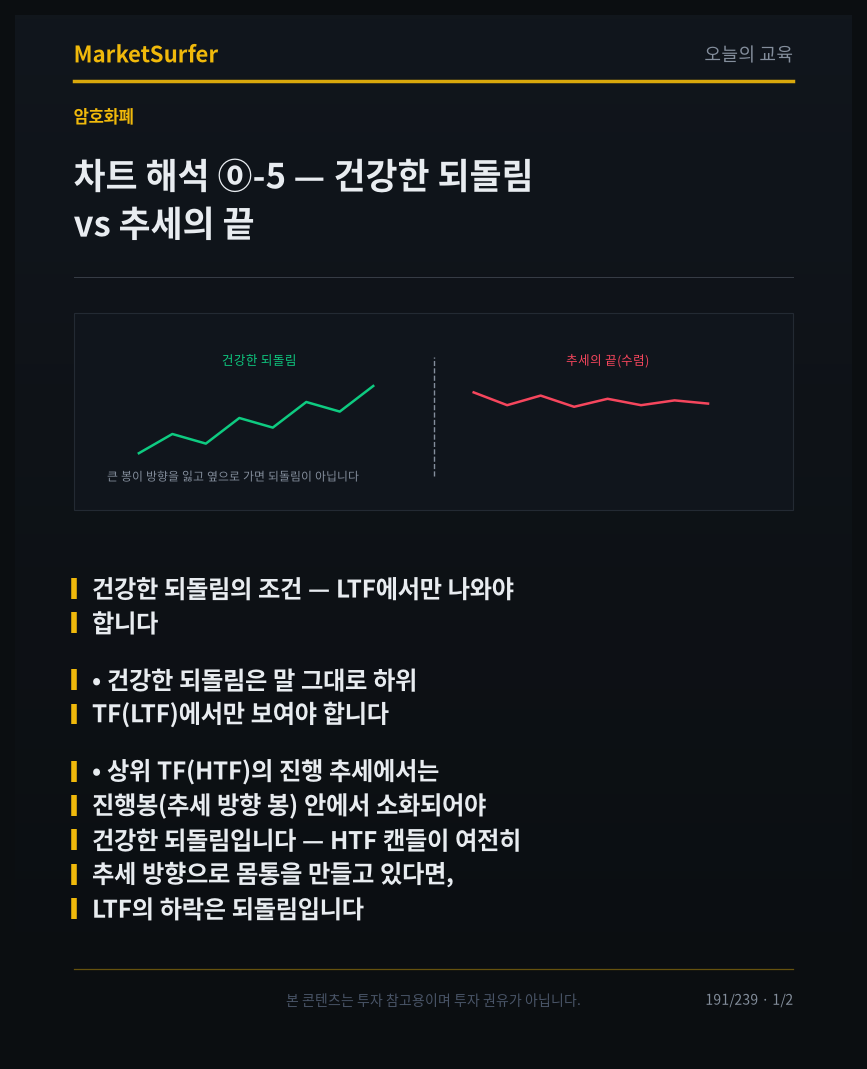

The condition for a healthy pullback — it must appear only on the LTF
• A healthy pullback should be visible only on the lower timeframe (LTF)
• To be healthy, it should be absorbed within the trending candles (candles in the trend direction) of the ongoing higher-timeframe (HTF) trend — if HTF candles are still forming bodies in the trend direction, a decline on the LTF is a pullback
The end of a trend — if the HTF goes into convergence, it is over
• Conversely, if the HTF itself stops making new highs or lows and enters a convergence stretch, that is not a pullback but the end of the trend
• Order of identification: ① on which timeframe is this correction visible → ② are the HTF trending candles still intact → ③ has the HTF stopped making new highs or lows and gone sideways (linked to the ⓪-4 convergence identification)
Connection to our data
• MarketSurfer's multi-timeframe trend alignment (6 TF) automates this distinction — if only the lower timeframe is opposite and higher-timeframe alignment holds, it is a pullback; if the higher timeframe also reverses or converges, the trend is re-evaluated
Where people slip
• They mistake an LTF pullback for a trend reversal and exit early, or conversely hold on, calling it a 'healthy pullback', when the HTF has already entered convergence — the criterion is not feeling but on which timeframe it appears
When unsure whether it is a pullback or the end, check just one higher timeframe. If the trending candles are alive it is a pullback; if it has stopped making new highs or lows and is converging, it is the end.
Have you ever held on, judging a move to be a pullback, when it was the end of the trend? What did the higher timeframe look like then?