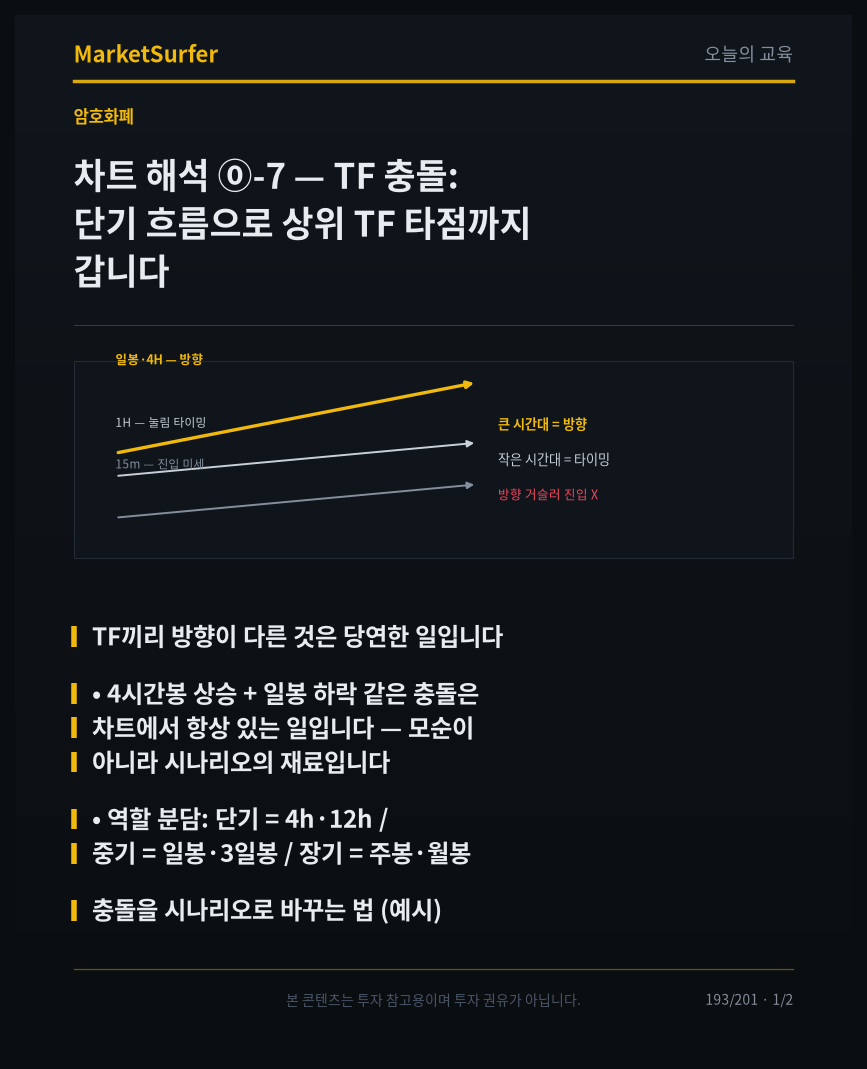

It is natural for timeframes to point in different directions
• Conflicts such as a rising 4-hour chart against a falling daily chart are always present — it is not a contradiction but material for a scenario
• Roles are divided as follows: short term = 4h and 12h / medium term = daily and 3-day / long term = weekly and monthly
How to turn a conflict into a scenario (example)
• If the short term (4h, 12h) is rising and the medium term (daily) is falling — assume it will rise, following the short-term flow, and find the daily resistance that rise will reach
• At that resistance, look for a short in line with the medium-term direction (falling) — the short-term rise becomes the path that carries price to the higher-TF entry point
• The advantage of a higher-TF (daily and above) entry point: because the close happens once a day, the entry point does not change during the day — no need to chase it, just wait
Connection to our data
• This is why MarketSurfer presents the 1st to 3rd support/resistance separately for each timeframe — it is exactly the structure that combines reading the lower-TF flow with waiting at the higher-TF level
Where people slip
• On seeing a conflict they ask 'which one is right' and discard one side — nothing should be discarded; each side has its own role, with the lower TF for direction and the higher TF for location
The path price takes is read from the short-term flow, and the response at the higher-TF level follows the higher-TF direction. A higher-TF entry point does not change during the day.
When the 4-hour and daily directions differed, which did you trade along? How did it turn out?